What Pokémon Cards Should I Collect? Pick a Lane Before You Buy
Most beginners buy a random booster pack, then a few singles off whatever's trending, then six months later they've spent $400 with nothing to show for it except a stack of cards in a drawer. The fix is not "buy smarter." The fix is to pick a lane first, then buy.
A collection lane is just a goal with rules. It tells you what to buy, what to skip, and when you're done. Six lanes cover roughly 95 percent of serious Pokémon TCG collectors. One of them probably already matches what you actually enjoy.
This guide walks through all six, the budget you need for each, and a pre-purchase checklist that prevents the most common beginner mistakes.
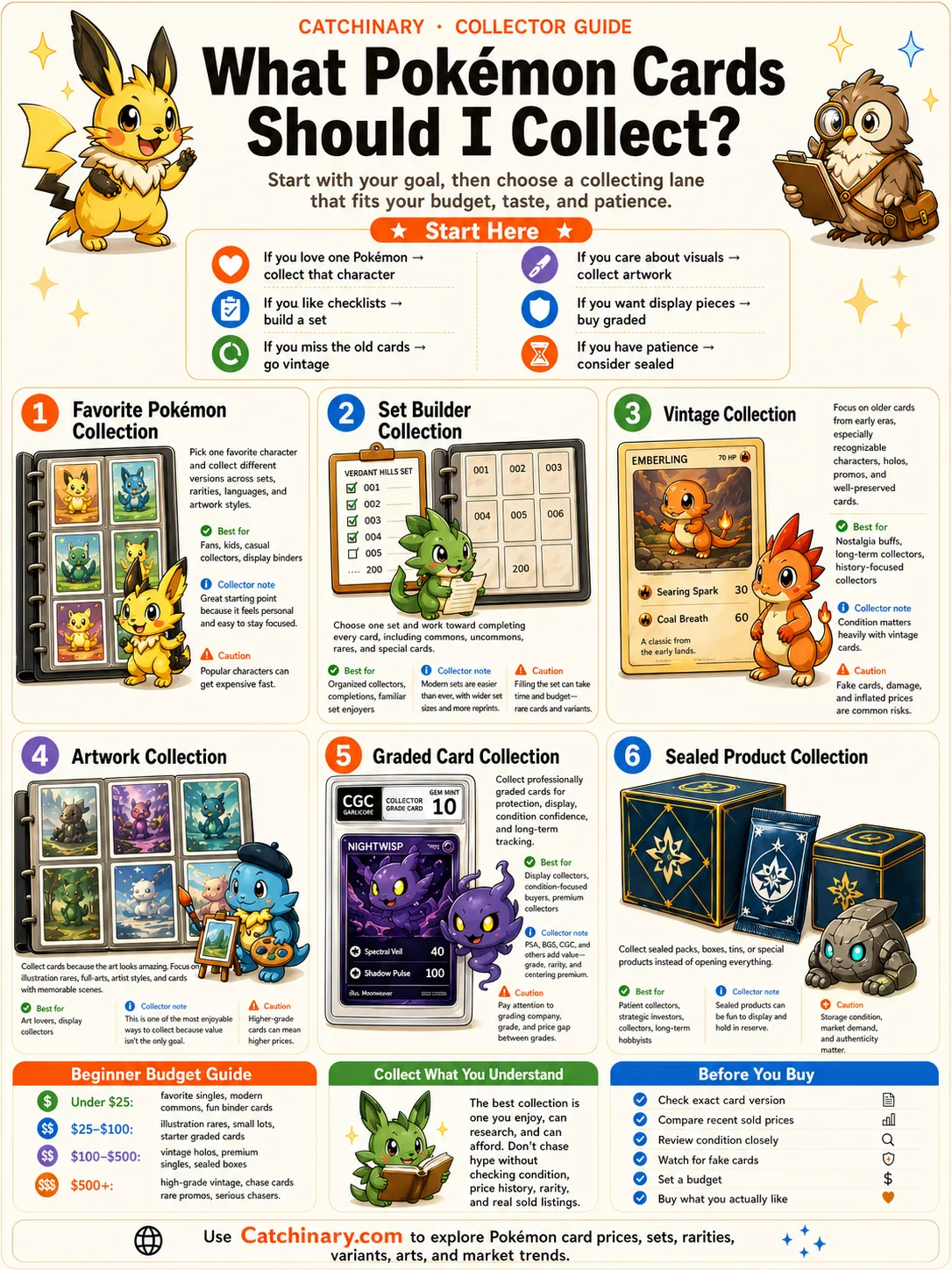
The 6 Pokémon Card Collection Lanes
Each lane attracts a specific personality. Read all six before deciding. The right lane is usually the one where you already have an opinion before reading the description.
01Favorite Pokémon Collection
Pick one Pokémon. Collect every printing.
Charizard collectors are the obvious example, but you can run this lane on any Pokémon: Lucario, Gardevoir, Eevee, Snorlax, Umbreon, Garchomp. The point is depth, not breadth. You're chasing one character across 25-plus years of print runs, languages, finishes, and special editions.
02Set Builder Collection
Complete the official checklist of one set.
Modern sets typically run 200-plus cards including secrets. Vintage sets are smaller (Base Set is 102 cards) but the high-rarity slots cost dramatically more. The appeal is the satisfaction of crossing names off a list and the binder that fills up in order.
03Vintage Collection
WOTC era (1999 to 2003) and early Nintendo era (2003 to 2007).
Base Set, Jungle, Fossil, Team Rocket, Neo Genesis, e-Card series, EX series. Vintage attracts buyers who want historical significance and proven scarcity. These prints have been out of production for two decades. Surviving copies in collectible condition keep getting rarer as cards leave the market into long-term collections, get graded into slabs, or get damaged.
04Artwork Collection
Buy cards because the art is great. Rarity is incidental.
Illustration Rares, alternate art, full-art prints, Special Illustration Rares, and the entire output of a specific artist (Mitsuhiro Arita, Akira Komayama, 5ban Graphics, Kouki Saitou). Visual impact is the only filter. We index every Pokémon TCG illustrator at /artists with their full body of work, sortable by ACIV.
05Graded Card Collection
Buy slabs only. PSA 9, PSA 10, BGS Black Label, CGC 10 Pristine.
The plastic case is part of the collectible. Graded cards remove condition uncertainty (the grade is fixed and verified) but add a 20 to 50 percent premium over raw cards. They also remove the option to upgrade individual conditions (you would have to crack the slab and resubmit).
06Sealed Product Collection
Booster boxes, ETBs, booster bundles, individual sealed packs.
Sealed appreciates over time as the cards inside leave the market. A factory-sealed Base Set booster box from 1999 sells for high five figures because the supply is finite and dropping. Modern sealed product follows the same trajectory but on a longer timeline.
Beginner Budget Guide
Your budget determines which lane is realistic. Here's the rough breakdown.
| Monthly budget | Realistic lanes | What you can buy |
|---|---|---|
| Under $25 per month | Favorite Pokémon, Artwork | Common and Uncommon prints, Reverse Holo commons, and Illustration Rares from current sets all sit in this range. You can fill a 9-pocket binder page in one purchase. |
| $25 to $100 per month | Set Builder, Favorite Pokémon, Artwork | Set builder becomes possible (one current set will take 6 to 9 months at this rate). Small holos and Reverse Holos from older sets become accessible. Starter graded cards (PSA 8 or 9 from modern sets) fit here too. |
| $100 to $500 per month | Vintage, Set Builder, Favorite Pokémon, Sealed (modern) | Vintage starts to open up. Holo rares from Neo Genesis and EX-era sets are findable. Premium singles from current sets (Special Illustration Rares of popular characters) fit here. Modern sealed booster boxes (one or two per month) become possible. |
| $500+ per month | All six lanes are realistic | High-grade vintage (PSA 8-plus on Base Set holos), chase cards from current sets in Special Illustration Rare or Hyper Rare slots, premium graded cards, and vintage sealed product. The question shifts from 'what can I afford' to 'what do I actually want.' |
Before You Buy: 6-Step Checklist
Use this checklist on every purchase over $50. Skipping any step is how beginners overpay by 30 to 80 percent.
- Check the exact card version. Same Pokémon, same set, multiple variants. 1st Edition versus unlimited, Reverse Holo versus Holo, Promo versus Set print, English versus Japanese. The variant changes the price more than the rarity.
- Compare recent sold prices. Look at the last 30 days of completed sales on TCGplayer, eBay sold listings, and PriceCharting. Three reference points beat one. Catchinary aggregates these into a median market price per card.
- Review condition closely. Look at the photos. Whitened corners, edge dents, surface scratches, off-centering, and printing defects all change value. If a seller refuses to send better photos, walk away.
- Watch for fake cards. Phone-flashlight test, weight test (modern cards are roughly 1.7g), CMYK rosette dot pattern under a 10× loupe, and the black core layer at the card edge. If two of those four fail, it's a fake. Our card identification guide covers each test in detail.
- Set a per-card and per-month budget. Write the numbers down. Stick to them. The Pokémon market has been on a long rip since 2020, but it does correct, and impulse buys at the top hurt the most.
- Buy what you actually like. This is the only rule that survives every market cycle. A Charizard you bought because you love Charizard is still satisfying when prices drop. A Charizard you bought because TikTok said it would moon is not.
Mixing Lanes (When It's OK)
The lanes aren't mutually exclusive. Most experienced collectors run two or three at once: a primary lane (the one they're most active in) and one or two secondary lanes for opportunistic buys.
Common combinations:
- Favorite Pokémon (primary) + Artwork (secondary). Buy every Charizard, but also any card whose art you can't put down.
- Set Builder (primary) + Vintage (secondary). Finish current sets while accumulating vintage holos as price opportunities appear.
- Graded (primary) + Sealed (secondary). Long-term value protection across two formats.
Avoid running all six lanes simultaneously. You'll over-spend, never finish anything, and the binder becomes incoherent. Pick a primary, accept that the others are tertiary, and most of the discipline takes care of itself.
FAQ
How many Pokémon cards are in the average personal collection?
Casual collectors typically have 200 to 1,000 cards across mixed sets. Active collectors run 2,000 to 10,000 cards once they pick a lane. Long-term collectors regularly cross 25,000 cards across binders, bulk storage, and slabs. Catchinary indexes 20,237 unique English-language prints, so a "complete English collection" is well-defined and finite.
Is collecting Pokémon cards a good investment?
Some Pokémon cards have outperformed the S&P 500 over five and ten-year horizons. Most have not. Investing-grade returns concentrate in roughly 5 percent of cards (high-grade vintage, sealed Base Set product, key chase cards in current sets). The other 95 percent trade flat or lose money. If you're collecting primarily for returns, you need the time and tools to identify the 5 percent. If you're collecting for enjoyment, the financial outcome is a bonus.
Which Pokémon cards are most likely to go up in value?
Three categories repeat the pattern: cards from the last set of a series (supply gets cut as the series transitions), cards featuring a popular Pokémon in a hyped artwork format (Special Illustration Rares of Pikachu, Charizard, Eevee), and graded gem-mint copies of vintage holos. Past performance is not future performance, but those three patterns have repeated for 20-plus years.
Should I open the booster boxes I buy?
This depends on the lane. If you're a sealed-product collector, no. Opening a 2026-era box now might be fun, but 10 years later that same box could be worth 3 to 5 times its current price specifically because it stayed sealed. If you're a set builder or favorite-Pokémon collector, yes. Singles from boxes you opened are still in your collection. Just decide before you buy.
Where can I check if a Pokémon card is real before I buy?
Catchinary indexes every English-language Pokémon print with images, set symbols, and collector numbers. Cross-check the listing against our card detail page. If the seller's photo doesn't match the printed details we show (set symbol shape, collector number format, copyright text positioning), the card is either a fake or mislisted.
How long does it take to complete a Pokémon TCG set?
Modern sets (200-plus cards) take 6 to 18 months at a $25 to $100 per month budget. Vintage sets take longer because the chase cards are scarce regardless of budget. Base Set first prints take many collectors 5-plus years to complete, and the 1st Edition shadowless variant takes most of a decade.
Is it worth getting cards graded?
Grading makes sense for cards that are likely to grade PSA 9 or 10 and are worth at least $100 raw. Below that threshold, the grading fees ($25 to $200 per card depending on tier and turnaround) eat the value uplift. Above that threshold, the grading premium typically clears the fee. Always pre-screen cards yourself for centering, edges, surface, and corners before submitting.