How to Identify a Pokémon Card: 10 Things on the Card That Tell You Exactly What You Have
"Is this card real?" "What set is this from?" "Is this rare?" These are the three most-asked questions on Pokémon TCG forums every single day. Every answer lives on the card itself. You just need to know where to look.
The card has 10 visible signals that, taken together, identify the exact print, set, variant, and approximate value. Here's what each one means and how to read it.
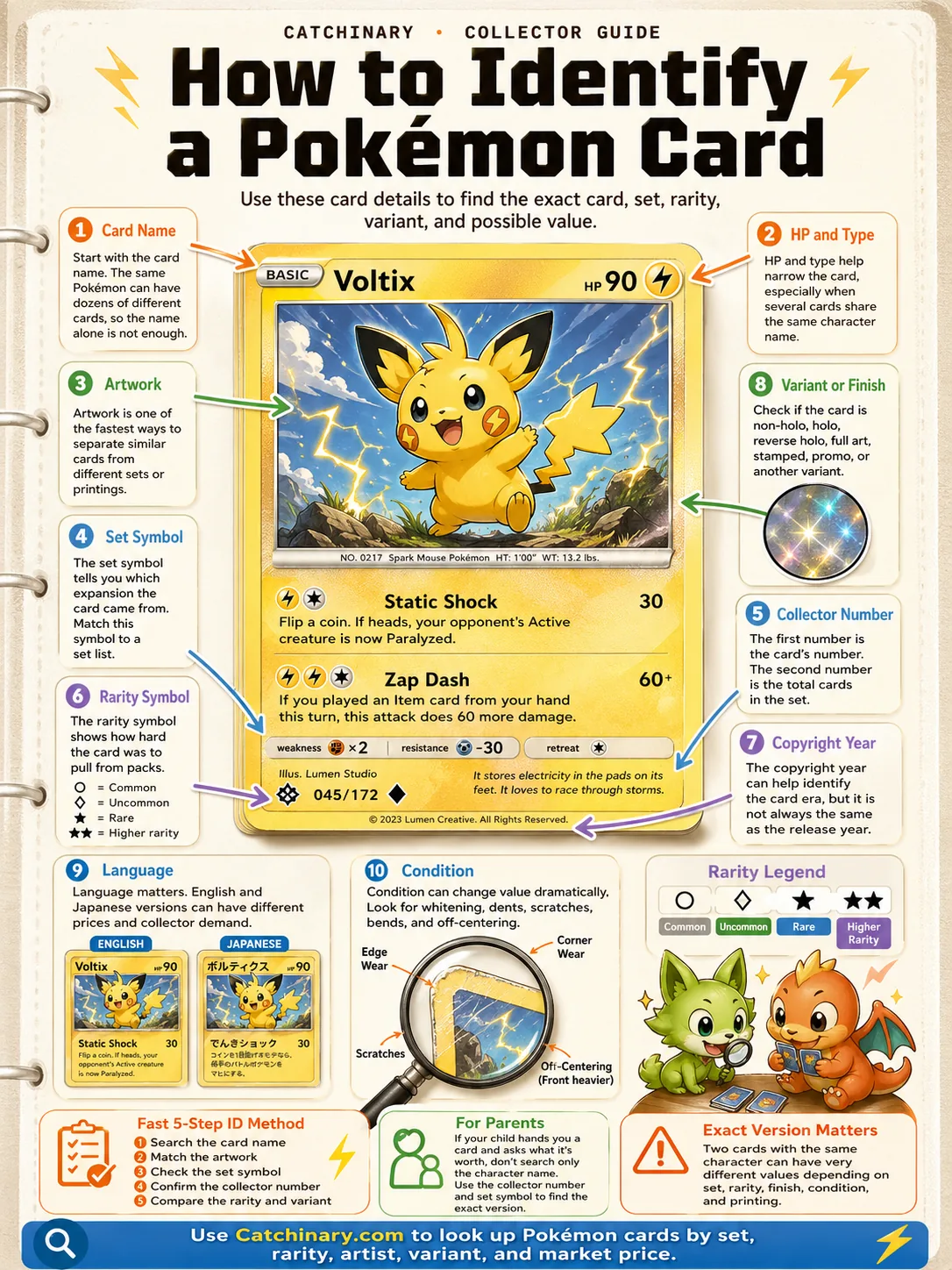
01Card Name
Start with the card name. The same Pokémon can have dozens of different prints, so the name alone is not enough. The name tells you which Pokémon you're looking at; the set, number, and variant tell you which specific print of that Pokémon. Look at the top-left corner of the card frame for the name in bold typography.
02HP and Type
Top-right corner. The HP number and type icon (Fire flame, Water droplet, Lightning bolt, etc.) narrow the card down significantly. The same character name often exists across multiple types in the franchise (Mega Charizard X is Dragon-type, Mega Charizard Y is Fire-type, the original Charizard is Fire). HP also shifts between print eras: the Base Set Charizard is 120 HP, while modern Pokémon ex versions can reach 330 HP.
03Artwork
Artwork is one of the fastest ways to separate similar cards from different sets or printings. Compare the pose, the background scene, the perspective, and any artist-specific signatures. The illustrator credit appears in tiny text at the bottom of the artwork box. Mitsuhiro Arita drew the original Charizard and many vintage staples; modern artists like 5ban Graphics, Ryuta Fuse, and Kouki Saitou produce the modern chase-card art.
04Set Symbol
The set symbol is the small icon near the bottom of the card, sitting just before the collector number. It tells you which expansion the card came from. Each set gets its own glyph: Base Set has no symbol at all, Jungle has a flower, Fossil has a fish skeleton, Neo Genesis has a star inside a circle, and modern Scarlet & Violet sets use stylized letters. Match this symbol against a set list to find the release year and full set name.
05Collector Number
The collector number sits at the bottom of the card, formatted like 045/172. The first number is the card's index within the set. The second number is the total set count. If the first number is higher than the second (e.g., 178/172), the card is a Secret Rare printed beyond the official set total. Modern sets often add Special Illustration Rares and Hyper Rares in this range.
06Rarity Symbol
The rarity symbol shows how hard the card was to pull. A black circle marks Common cards, a black diamond marks Uncommon, a black star marks Rare, two stars mark Double Rare or Ultra Rare, and three stars mark Hyper Rare or Secret Rare. The rarity symbol is signal but not the answer on price. A Common Charizard from 1999 routinely outsells a Hyper Rare from a 2024 set. We have a complete breakdown at our rarity guide.
07Copyright Year
Tiny copyright text along the bottom-right edge of the card lists the year of the print run, the set's licensor lineage (Nintendo / Creatures / GAMEFREAK / The Pokémon Company), and sometimes the artist's copyright statement. The year tells you the print era, which is one of the four signals our CIV score uses to rank cards. Note: the copyright year is the year of the print run, not necessarily the year the Pokémon character was created.
08Holo or Finish
Check whether the card is non-holo, holo, Reverse Holo, full art, alt art, gold-foil, rainbow-foil, or stamped (championship, prerelease, anniversary, or promo). Finish is the single biggest source of confusion when identifying modern variants. A Reverse Holo of a Common Pokémon can be worth more than the standard Holo Rare from the same set if the character is popular. Tilt the card under bright light to confirm the foil pattern.
09Language
English and Japanese versions exist for nearly every modern card, with Korean, Chinese (Traditional and Simplified), French, German, Italian, Spanish, Portuguese, and Russian rounding out the major print regions. Japanese cards are typically smaller in HP-stat-block typography but the same physical dimensions (63 × 88 mm). Foreign prints are a frequent source of pricing surprise: Japanese first prints often trade at premiums over their English equivalents because the Japanese market gets sets first and collectors chase early-print copies.
10Condition
Condition can change value dramatically. Look for whitening on the corners, dents on the edges, scratches and surface scuffs across the holofoil, off-centering of the artwork, and any printing or factory defects. Modern sellers typically grade as Near Mint, Lightly Played, Played, or Damaged. Vintage cards have a separate market for played copies because gem-mint copies are scarce. For graded slabs, PSA, BGS, and CGC are the dominant third-party services.
The 5-step fast ID method
For most cards, this 5-step sequence narrows the print to one specific entry in under a minute:
- Search the card name on Catchinary's card index. You'll see every English print side-by-side.
- Match the artwork against the search results. Visual match is the fastest filter.
- Check the set symbol against the candidate. Symbols are unique per set and rule out wrong matches immediately.
- Confirm the collector number. The 045/172 style is the same on the card and on Catchinary's listing.
- Compare the variant and rarity. Holo, Reverse Holo, 1st Edition, Promo. Variant changes price more than rarity tier.
Foreign prints and regional variants
Foreign cards are the #1 identification confusion on Pokémon collecting forums. Reddit threads on this topic regularly draw hundreds of comments and run weekly. Here's the regional map:
| Region | Language code | Tells |
|---|---|---|
| English | EN | The default reference. Latin alphabet text. Blue-and-yellow Pokémon back design. |
| Japanese | JP | Hiragana, katakana, and kanji on card name and attacks. Pikachu's silhouette in the background of the back design instead of the standard Pokéball motif on some sets. |
| Korean | KO | Hangul script. Modern Korean prints use a back design very similar to English. Korean PSA 10 grades sometimes carry premiums in collector markets. |
| Chinese (Simplified) | CN-S | Simplified Chinese characters. Distinctive layout with a regional logo. Currently mid-tier collector demand. |
| Chinese (Traditional) | CN-T | Traditional characters. Used in Hong Kong and Taiwan markets. |
| European (FR / DE / IT / ES / PT) | various | Each language gets its own print run with native-language text. Generally trades at a discount to English on the same card. |
Across over 180 community posts on r/PokemonTCG, r/pkmntcgcollections, and r/PokeInvesting that we sampled, "Japanese vs English" came up 65 times. "Foreign / Korean / Chinese" came up another 21 times combined. Knowing the language is the difference between a $10 estimate and a $300 estimate on the same character.
Why the exact version matters
Two cards with the same character name can have wildly different values. The same Charizard from Base Set 1999 trades for $300 to $1,200 depending on whether it's 1st Edition shadowless, 1st Edition non-shadowless, unlimited shadowless, or unlimited non-shadowless. All four versions look almost identical to the casual eye.
Three signals separate them: the 1st Edition stamp (a small black stamp on the left of the artwork box), the shadowless versus shadow line on the right side of the artwork frame, and the copyright text at the bottom. The price difference between the highest and lowest version is roughly 4× to 5×.
This is why "the card is from Base Set" is not enough. The exact version, condition, and grade together drive the price. Skip any one of those checks and you mis-price.
FAQ
How do I identify which set a Pokémon card is from?
Look for the small symbol near the bottom of the card next to the collector number. Each Pokémon TCG set has a unique symbol. Match that symbol against a set list on Catchinary's set index or Bulbapedia to find the set name and release year.
What is the collector number on a Pokémon card?
The collector number sits at the bottom of the card and uses the format 045/172. The first number is the card's index within the set; the second is the official total set count. If the first number is higher than the second (e.g., 178/172), the card is a Secret Rare printed beyond the official set total.
How can I tell if a Pokémon card is fake?
Five quick checks: phone flashlight behind the card (real cards stay opaque, fakes glow through), weight (~1.7g for real modern cards), HP digit kerning under a 10× loupe, the CMYK rosette dot pattern (fakes show linear stripes or solid color), and the black core visible at the card edge (fakes are pure white through-cut).
How do I tell English vs Japanese Pokémon cards apart?
Japanese cards have Japanese text on the card name, attack names, and flavor text. The card back design also differs between Japanese-only sets and English-market sets. Korean and Chinese versions follow similar patterns with their own character sets.
Why does the variant of a Pokémon card matter for value?
The same Pokémon in the same set can exist in multiple variants. A Reverse Holo Common can outsell the standard Holo Rare from the same set, and a 1st Edition stamp can multiply the price of a vintage card by 5× to 10×. Always confirm the exact variant before pricing.