Pikachu Card Evolution: 8 Eras of Design from 1999 to 2026
Pikachu has appeared in every Pokémon Trading Card Game era since 1999. That makes Pikachu the single best Pokémon for tracing how TCG card design has actually evolved. Same character, same color palette, dramatically different cards across each generation.
Here are the 8 design eras, what changed in each, and which Pikachu cards from each era matter to collectors today.
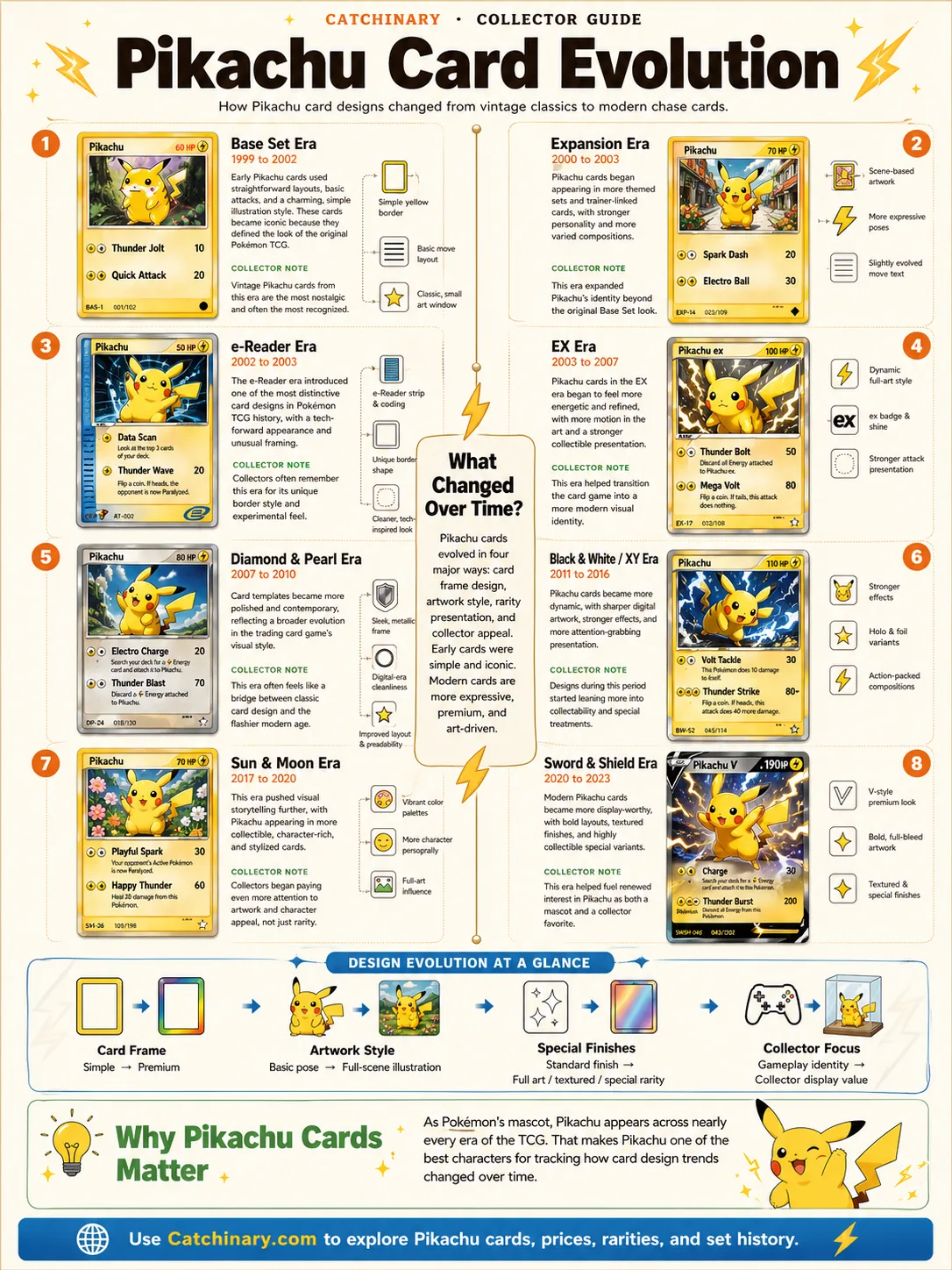
Base Set Era 1999 to 2002
Sample attacksThunder Jolt · Quick Attack
Yellow border, beige sky background, minimalist gameplay-first design. The original Base Set Pikachu defined the visual template for the entire franchise. Simple frame, no foil treatment beyond the standard Holo Rare slot, illustration-by-Mitsuhiro-Arita aesthetic. Vintage Pikachus from the WOTC era trade primarily on grade and 1st Edition stamp.
Collector note. Holo and 1st Edition Pikachu cards from this era carry strong vintage premiums. PSA 10 grades drive significant value.
Expansion Era 2000 to 2003
Sample attacksSpark Pack · Electric Ball
Design varied with each set. More expressive Pikachu poses appeared (running, attacking, mid-leap), and the framing began drifting away from the rigid Base-Set template. Set symbols proliferated and signaled a market trying to find its own visual identity beyond the original blueprint.
Collector note. Slightly higher print runs than Base Set make these less scarce, but specific holos still command attention.
e-Reader Era 2002 to 2003
Sample attacksEasy Scan
The e-Reader experiment introduced barcode strips along the bottom edge of every card, designed to interact with a Game Boy Advance accessory. The cards were physically wider than standard, broke the binder pages of the time, and remain a curiosity. Visually unique, largely unloved by competitive players.
Collector note. Collectors price the e-Reader Pikachu as much for its odd-format reputation as for its art.
EX Era 2003 to 2007
Sample attacksElectro Ball · Mega Bolt
The 'ex' mechanic introduced full-art-style Pokémon ex cards with much higher HP, more dynamic art, and the recognizable 'ex' tag in the corner. Pikachu ex cards from this era marked the first real chase-card treatment for the mascot beyond the standard holo slot.
Collector note. Strong precursors to modern ultra-rare design. Stronger demand on graded PSA 10 examples.
Diamond & Pearl Era 2007 to 2010
Sample attacksElectric Charge · Thunder Beam
Card frame polished, contemporary scenes appeared in the artwork (a Pikachu in a forest, a Pikachu on rooftops). Energy types remained color-coded, but the artwork was no longer fully gameplay-driven. It began telling small visual stories. Set rotation systems started here, accelerating the collector-vs-player split.
Collector note. Signature collectible Pikachus from this era trade as the bridge between vintage and modern.
Black & White / XY Era 2011 to 2016
Sample attacksVolt Tackle · Thunder Strike
Pikachu cards became increasingly cinematic, with wide-angle scenes, expressive character framing, and the introduction of Full-Art Pikachu rare variants. The XY era added 'Mega' mechanics, pushing chase-card foil treatments forward. EX cards of mascot Pokémon became cornerstone modern targets.
Collector note. Strong artwork eras. Full Art and EX Pikachus carry collector premium even outside graded scarcity.
Sun & Moon Era 2017 to 2019
Sample attacksPlayful Spark
Strong visual storytelling, with Pikachu appearing in more creative, character-emotional poses. GX-mechanic Pikachus and the introduction of Tag Team cards (Pikachu paired with another mascot like Zekrom or Charizard) created lasting chase moments. The Hidden Fates set delivered a Charizard-led era but Pikachu held its mascot footprint.
Collector note. Tag Team Pikachu cards remain visually iconic. Hidden Fates Pikachu carries era-defining premiums.
Sword & Shield Era 2020 to 2022
Sample attacksCharge · Thunder Burn
Modern Pikachu cards became the loudest visually. Bold layouts, futuristic foil treatments, hyper-rare special variants like rainbow-foil and gold-foil Pikachu VMAX. The era introduced V and VMAX mechanics and saw Special Illustration Rare Pikachus enter the chase-card conversation alongside era-defining Charizards.
Collector note. The era of modern grail Pikachus. Special Illustration Rare and rainbow-foil VMAXes drive the high end.
Design evolution at a glance
Across 25 years, four design dimensions tell the story of how the Pokémon TCG transitioned from a gameplay product to a collectibles product:
| Dimension | 1999 (Base Set) | 2026 (modern) |
|---|---|---|
| Card frame | Simple yellow border | Premium foil edges, varied border treatments |
| Artwork style | Static gameplay illustration | Full-scene cinematic art, character storytelling |
| Special finishes | Standard Holo Rare | Full-art, Hyper Rare, rainbow-foil, gold-foil treatments |
| Collector focus | Gameplay identity | Display value, scarcity, grading |
Why Pikachu cards matter
As Pokémon's mascot, Pikachu appears across nearly every era of the TCG. That makes Pikachu one of the best characters for tracing how card design trends have actually changed over time. The frame, the foil, the framing. Every shift in TCG design philosophy shows up on a Pikachu card first.
For collectors, this means Pikachu is a complete miniature museum of the franchise. Owning a Pikachu from each era gives you a tangible visual history of the entire game. It's the cleanest single-character investment thesis in the hobby.
For investors, it means Pikachu carries franchise-mascot recognition that other characters lose over time. Charizard outpaces Pikachu in headline auctions, but Pikachu's depth is unmatched. The sheer number of strong cards across the years carries the franchise.
FAQ
What is the most valuable Pikachu card?
Pikachu Illustrator (1998 promo) holds the record at over $5,000,000 for a verified PSA 10 sale. Among non-trophy cards, the 1st Edition Holo Pikachu from Base Set and various modern Special Illustration Rares carry the most weight.
How many Pikachu cards exist?
Over 250 distinct Pikachu cards have been printed across the English Pokémon TCG since 1999, including basic, holo, full-art, ex, V, VMAX, and special illustration variants. Catchinary indexes every English print.
Why does Pikachu appear in so many sets?
Pikachu is the franchise mascot. Including a Pikachu in every era guarantees mascot recognition for new players and gives The Pokémon Company a recurring chase character that drives demand across decades.
Are old Pikachu cards worth money?
Some are. The Base Set Holo Pikachu, 1st Edition Jungle, certain promos, and Pikachu Illustrator carry significant value. Most non-holo Pikachus from the WOTC era trade for under $20 raw, with PSA 10 grades adding meaningful premiums.
What is the rarest Pikachu card?
Pikachu Illustrator is the rarest mainstream Pikachu card, with fewer than 40 known copies. Trophy promos like the No.1 Trainer Pikachu from the 1997 Tropical Mega Battle are even rarer at single-digit population counts.