Pokémon Card Rarity Symbols Explained: Every Symbol, What It Means, How It Affects Value
The tiny symbol at the bottom of every Pokémon card tells you exactly how rare it is. Or more accurately, it tells you the official rarity bucket the print run dropped into. That bucket is one of the four signals that actually drive a card's value.
Modern Pokémon TCG (Sword & Shield era forward) uses seven rarity tiers, each with its own symbol. Pre-2003 vintage uses a simpler three-tier system. Here's the complete map.
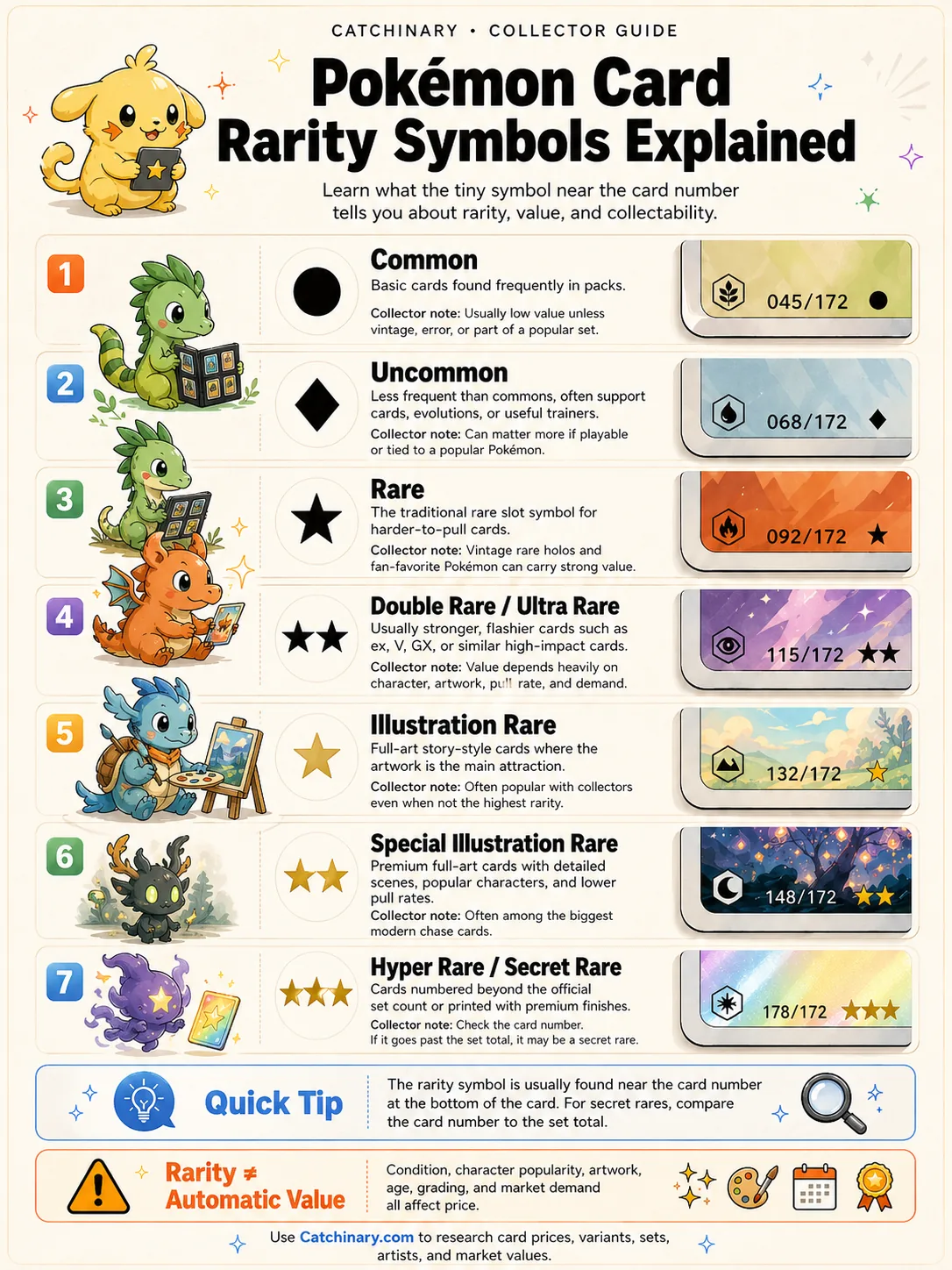
Where the rarity symbol lives on a Pokémon card
On modern cards (2020 onward), the rarity symbol sits at the bottom of the card, between the collector number and the set abbreviation. The collector number itself ("045/172" for example) tells you the card's index within the set.
On older Wizards-of-the-Coast era cards (Base Set through e-Card era, 1999 to 2003), the symbol sits in the bottom-right corner of the artwork box. The structure is the same. Symbol indicates rarity, number locates the card within the set.
Quick check. Hold the card with the artwork facing you. Look at the bottom edge. The symbol you see, whether circle, diamond, or star, is the rarity tier.
Common ●
The black filled circle marks Common cards. They are the most-printed tier. A booster pack is mostly commons by volume.
Most commons trade for under a dollar even in Near Mint. The exceptions are vintage commons in graded high condition (a PSA 10 Base Set Common can clear $50), error prints, and commons featuring breakout Pokémon that later become valuable. The 1999 Base Set Energy commons trade for several dollars graded purely on age and nostalgia.
Uncommon ◆
The black diamond marks Uncommons. These are typically support cards, basic-stage Pokémon evolutions, and trainer cards. About a third of a booster pack is uncommon.
Uncommons matter more to competitive Pokémon TCG players than collectors. A useful trainer card or staple Supporter from a current-format set can hold $5 $15 even at this rarity if it's tournament-relevant. Outside competitive utility, most uncommons follow commons into the bulk box.
Rare ★
The black star marks the traditional Rare slot. One card per pack in modern boosters. Pre-2003 vintage uses the same star for both regular Rares and Holo Rares (the holographic foil treatment was a separate visual indicator, not a separate rarity tier).
This is where collector value starts to live. Vintage rare holos featuring iconic Pokémon (Charizard, Blastoise, Venusaur, Lugia, Mewtwo) carry significant value even ungraded. Modern rares are split between collectible and bulk depending on character recognition and tournament play.
Double Rare / Ultra Rare ★★
Two black stars mark Double Rare or Ultra Rare cards. These include the foil-effect chase tiers like ex, V, VMAX, GX, EX, and similar mechanic-driven Pokémon variants.
Pull rates run roughly 1 in 6 to 8 packs. Value depends heavily on which Pokémon is on the card, the artwork, and the format's competitive demand. A current-meta Pokémon ex with strong attack stats can hold $20 $60 even right after a set release. Off-meta Ultra Rares from older sets often drop into single dollars.
Illustration Rare
Illustration Rare introduced the modern full-art collector tier. The Pokémon takes center stage in a story-style scene that fills the entire card frame. No text box border, no top stripe, just art and a simple lower nameplate.
Pull rates run roughly 1 in 12 packs. Even when not the highest-rarity card in a set, Illustration Rares are often the most-collected tier because the art outweighs the mechanical scarcity. Strong artwork on a popular Pokémon can outprice the Special Illustration Rare from the same set.
Special Illustration Rare
The premium tier. Special Illustration Rares are full-art cards with elaborate scenes, often featuring a Pokémon alongside its trainer or a setting tied to lore. Pull rates run roughly 1 in 25 to 40 packs.
This is where modern chase cards live. Moonbreon (Umbreon VMAX Alt Art from Evolving Skies, 2021) is the canonical example. It traded above $1,000 raw at peak and became the de-facto poster child for the tier. Special Illustration Rares of iconic Pokémon are the modern era's grail-tier cards.
Hyper Rare / Secret Rare ★★★
Three black stars (or in some sets, no star with the card numbered beyond the set total) mark the Hyper Rare and Secret Rare tier. These cards are printed past the official set count. If a set has 172 cards, a Secret Rare might be numbered 178/172.
Visual cues: rainbow-foil, gold-foil, or specialized premium finishes. Pull rates are the lowest in the set, often 1 in 80+ packs.
The fastest way to spot a Secret Rare. Look at the collector number. If the first number is higher than the second (e.g., 178/172), the card is Secret Rare regardless of which star treatment is used.
Why rarity does not equal value
The rarity symbol tells you how scarce the card was at print time. It does not tell you what the card is worth today.
Catchinary's CIV score blends four signals to answer that second question: market momentum, grading upside, character icon status, and era strength. Rarity is implicit in those. It shows up as an input to grading upside and to era strength, but never as a standalone factor.
| Card | Rarity | Approx value |
|---|---|---|
| Charizard, Base Set 1999, Holo Rare | Rare ★ | $300 $1,200 raw |
| Pokémon ex, current Scarlet & Violet set | Hyper Rare ★★★ | $8 $40 |
| Common Magikarp, Base Set 2 1999 | Common ● | Under $1 |
| Moonbreon (Umbreon VMAX Alt Art) | Special Illustration Rare | $300 $1,500+ |
The Common from 1999 is "rarer" by print number than a freshly-pulled Hyper Rare, but it's not worth more. The Hyper Rare from a current set has a lower print run than the Moonbreon, but a generic Hyper Rare often trades for less than a popular Special Illustration Rare. The symbol is signal, not the answer.
FAQ
What is the rarest Pokémon card symbol?
The three-star Hyper Rare / Secret Rare designation is the rarest in-print symbol in modern sets. Cards numbered beyond the official set count (178/172, for example) sit in this tier. They print on premium foil finishes and have the lowest pull rates of any rarity in the booster.
Where is the rarity symbol on a Pokémon card?
Modern cards (2020 onward): bottom edge, between the collector number and the set abbreviation. Vintage cards (1999 to 2003): bottom-right corner of the artwork box.
Does a higher rarity symbol mean more money?
Not always. A Common Charizard from Base Set 1999 routinely outsells a Hyper Rare from a 2024 set. Rarity is one signal among four. Character recognition, era, condition, and grading status all factor in. CIV is Catchinary's all-in-one score.
What is the difference between Illustration Rare and Special Illustration Rare?
Both are full-art cards. Illustration Rare features the Pokémon in a story-style scene. Special Illustration Rare is a premium tier with more elaborate scenes (often a Pokémon alongside its trainer), lower pull rates, and modern chase-card status.
How can I tell if a card is a Secret Rare?
Compare the card's collector number to the set total. If the first number is higher than the second (e.g., 178/172, where 172 is the set total), the card is printed beyond the official set and counts as Secret Rare.