How to Value Pokémon Cards: What 20,237 Cards Tell Us About What They're Worth
You have a card, or a stack of them, and you want to know what they're worth. Most "Pokémon card value" guides online are either thin price-guide pages or affiliate funnels that send you to eBay and call it a day.
This one is different. We pulled the full Catchinary dataset and looked at what actually predicts price. Here's the four-step process.
Step 1: Identify the card precisely
Two cards with the same Pokémon name can have wildly different values. You need all four pieces of the identifier:
| Identifier | Where to find it |
|---|---|
| Pokémon name | Top of the card |
| Set name | Symbol next to the HP value |
| Collector number | Bottom corner (e.g. 4/102) |
| Variant | Holo, Reverse Holo, 1st Edition, Promo |
Watch the Reverse Holo trap. A Reverse Holo Common can outsell the standard Holo Rare from the same set, but Reverse Holos of unloved Pokémon trade for pennies. Variant matters as much as the rarity stamp.
Step 2: Pull the live market price
Two sources, both worth checking:
| Source | What it tells you | When to trust it |
|---|---|---|
| TCGplayer Market Price | Algorithmic average of recent sales | Default for most cards (95% of catalog) |
| eBay sold listings | Last 50 actual sales for that exact card | When TCGplayer is stale or the card spiked |
Catchinary's card pages show both inputs on one screen plus a price history chart, so you can see whether the card is climbing, falling, or flat before you trust a single number.
Step 3: Adjust for condition
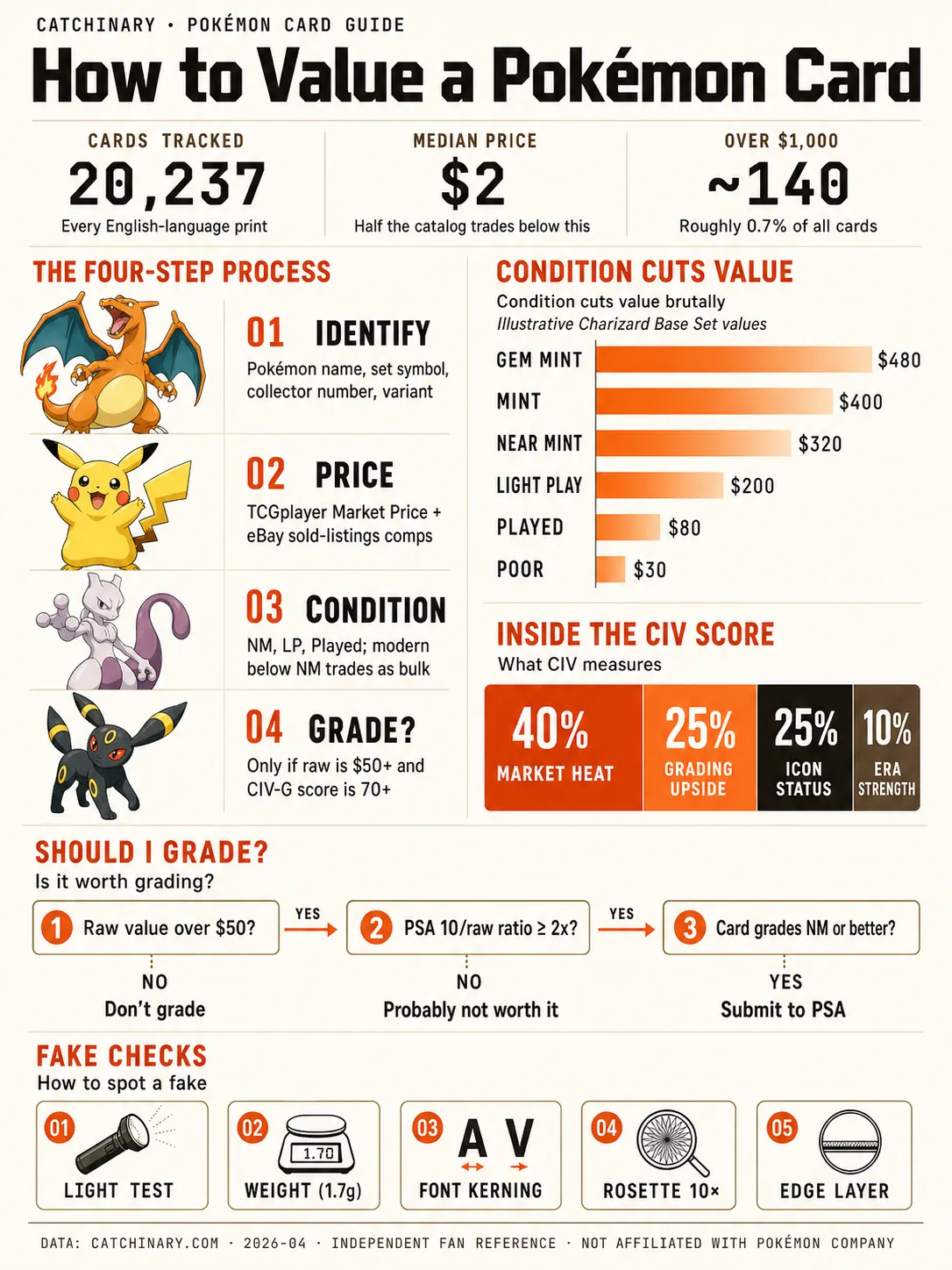
Condition cuts value brutally. Here's what a Near Mint Base Set Charizard looks like priced down through the grades:
That's an 80% discount for a card that still looks recognizable across the room. For modern cards (post-2020), Near Mint is the floor most buyers expect. Anything below NM is bulk.
Step 4: Decide whether to grade
This is where most casual sellers leave money on the table or, more often, light it on fire.
| Raw value | What to do | Why |
|---|---|---|
| Under $50 | Don't grade | Grading costs $20 $30. PSA 10 has to roughly double to break even, and the 9 outcome is common. |
| $50 $200 | Check CIV-G score | Grade if PSA 10 is 2x+ raw. Skip if the ratio is below. |
| Over $200 | Grade it | Locks in authenticity, freezes condition disputes, unlocks slabbed-only buyer pool. |
Catchinary's CIV-G score does the math for you per card. Charizard from Base Set sits north of 90. A 2023 common sits at 0.
What our data shows about Pokémon card value
We sit on every English-language Pokémon card with a TCGplayer market price plus historical price data going back to 2008. A few patterns from the dataset that almost no other site will give you for free:
Era beats rarity
A Common from 1999 Base Set routinely outsells a Rare Holo from a 2024 set. The era multiplier alone explains a huge slice of the price range. Rarity stamp on the card is a weak signal compared to which year and which set it came from.
The expensive cards cluster tightly
If you have an old binder with hundreds of cards, the realistic outcome is fewer than ten of them are worth more than a meal. The top one or two carry almost everything. The long tail genuinely is bulk.
How to spot a fake (5-second checks)
| # | Test | What to look for |
|---|---|---|
| 01 | Light test | Real cards have an opaque core. Fakes glow when a phone flashlight is held behind them. |
| 02 | Weight | Real modern card: ~1.7g. Fakes are usually lighter. |
| 03 | Font & kerning | HP digit kerning and energy-circle thickness give fakes away under a loupe. |
| 04 | Rosette pattern | Real cards show CMYK dot rosettes at 10×. Fakes show linear stripes or solid color. |
| 05 | Edge layer | Real cards have a black layer visible at the edge. Fakes are pure white through-cut. |
How Catchinary speeds this up
Type a card name into the search bar at catchinary.com, click the right printing, and get all of it on one page: live TCGplayer Market Price across every variant, the price history chart, the eBay listings strip, the PSA 10 vs raw history, and the CIV score that summarizes the whole picture from 0 to 100.
Free, no account needed, no commission baked into the prices.
FAQ
Are Pokémon cards from the 1990s always worth money?
No. Plenty of binders from that era hold $20 worth of cards because they're commons in beat-up shape. The 1999 to 2003 era is the high-value era, but only specific cards from it: Holo Rares, iconic characters, 1st Edition stamps, anything Near Mint or better.
Can I check Pokémon card values without making an account?
Yes. Catchinary, TCGplayer's price guide, and Cardmavin all let you look up cards anonymously. Catchinary's price history, market data, and CIV score are public on every card page.
How accurate is the TCGplayer Market Price?
Within 10% of fair value for cards that trade often. For low-volume or recently spiked cards, it can lag eBay by a few weeks. We chart both inputs together so you can spot the gap.
Should I grade my Pokémon card?
Only if its raw value is $50 or higher, the card is genuinely Near Mint or better, and the PSA 10 to raw ratio is at least 2x. Below those thresholds, grading typically costs more than the price bump it produces.
What is CIV?
CIV stands for Catchinary Index Value. A 0 to 100 score that blends price momentum, grading upside, character icon status, and era strength into a single number per card. Full methodology at /civ.